
Saltoro Valley pakistan guide is for those who are looking for a plan without rush. Saltoro Valley is located in the far eastern Karakoram, deep inside Gilgit-Baltistan. What you find here is pure, wild landscape, huge peaks scraping the sky, glaciers everywhere, and a silence you don’t get anywhere else. The Saltoro Range cuts through the valley like a wall between Baltistan and the frozen world of Siachen Glacier.
Saltoro Valley on the Map
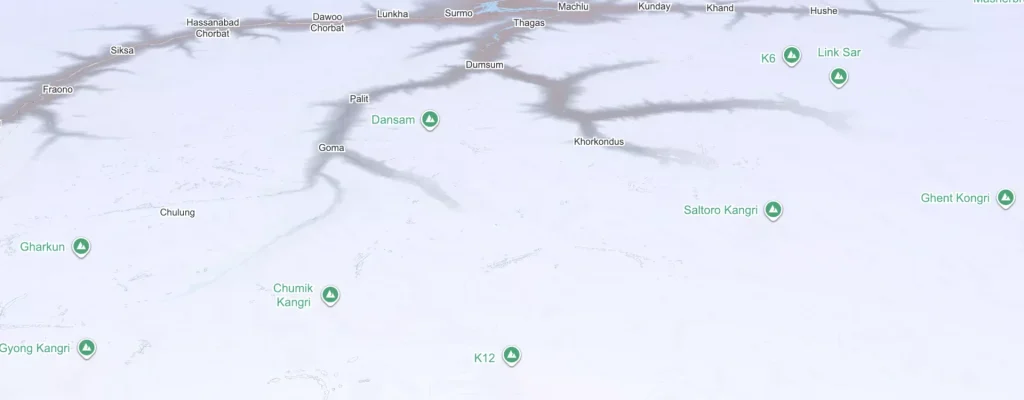
If you are looking for Saltoro on a map, start from Khaplu (the last district of Gilgit Baltistan) and keep heading east. You’ll run into it eventually, jammed up right next to the Siachen Glacier, tangled in some of the roughest country the Karakoram has to offer. Getting there isn’t straightforward; you have to snake through remote corners of Baltistan.
The Saltoro Range
Saltoro Valley isn’t just another spot in the mountains. Compared to other regions, Saltoro feels like another planet: barely any people, just wild glaciers and rock, peaks that punch above 7,000 meters, and a heavy, almost ghostly quiet. If you’re looking for true wilderness in Pakistan, this is about as real as it gets.
Major Peaks of Saltoro Valley
Saltoro Kangri (7,742 meters)
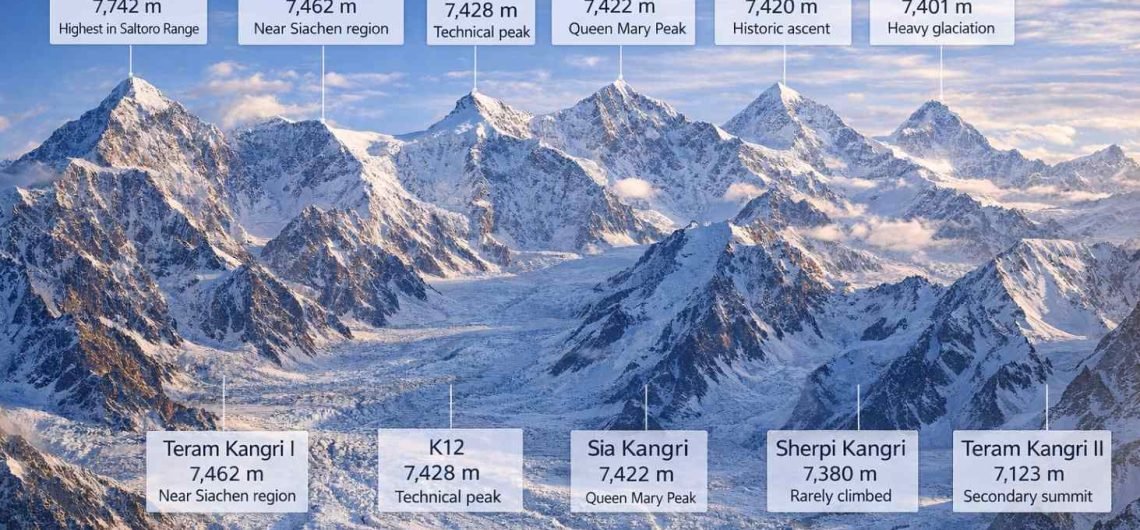
Saltoro Kangri, also known as K10, is the highest, reaching 7,742 meters. A Japanese team climbed it back in the 1960s, but it still looms over everything.
Teram Kangri I (7,462 meters)
Teram Kangri I is at 7,462 meters. It is rarely attempted due to its extreme remoteness.
Sia Kangri (Queen Mary Peak)
Sia Kangri (7,422 meters) is all about endless glaciers and nasty weather. The peak is notable for its massive glacial surroundings and harsh weather conditions.
Abruzzi Peak (7,420 meters)
Abruzzi Peak has historically been quite significant in early Karakoram exploration.
Sherpi Kangri (7,380 meters)
Sherpi Kangri is so remote, just getting there is the real challenge.
Teram Kangri II (7,123 meters)
Teram Kangri II, 7,123 meters, might be a secondary summit, but it’s still a serious climb.
Glaciers of Saltoro Valley
Glaciers really run the show here. Kondus, Bilafond, and Gyang glaciers cut up the land and feed into the Siachen system.
These glaciers feed into the broader Siachen system and play a crucial role in regional hydrology and climate regulation.
Trekking and Tourism in Saltoro Valley
Saltoro Valley is not a conventional trekking destination. Unlike in the Hunza, Shigar, Hushey, or Skardu, infrastructure is minimal here. Access is restricted, and travel is limited to.
For travelers, Saltoro Valley remains a geographical reference point rather than a visitable destination.
Wondering about the best time to go?
You probably won’t always get the chance. There’s a short window (June to August). It isn’t recommended during winter, but during the summer, you can go deep in the valley. This Saltoro valley guide will help you find the best time and season.
Permits are tight
Being on the LOC, you need official approval to move in the valley, for security reasons. Which is why it’s stayed off the tourist radar. Saltoro Valley, Pakistan, the guide will take care of your permits and all the authorisation processes.
Cultural and Environmental Importance
Life along the fringes of Saltoro is tough. Down in lower Baltistan, Balti communities scrape by, herding and moving with the seasons. The land is fragile, the culture runs deep, and those mountains? They don’t give up their secrets easily.
Why Saltoro Valley Matters
As interest in sustainable and responsible travel grows, understanding regions like Saltoro Valley becomes essential, even if they are not open for tourism.
Final Thoughts
Saltoro Valley remains Pakistan’s last true alpine frontier. Defined by towering 7,000-meter peaks, massive glaciers, and extreme isolation, it holds immense geographical and scientific value. While not accessible for general travel, its mountains continue to shape Pakistan’s identity as one of the world’s great high-mountain countries.
Comments