
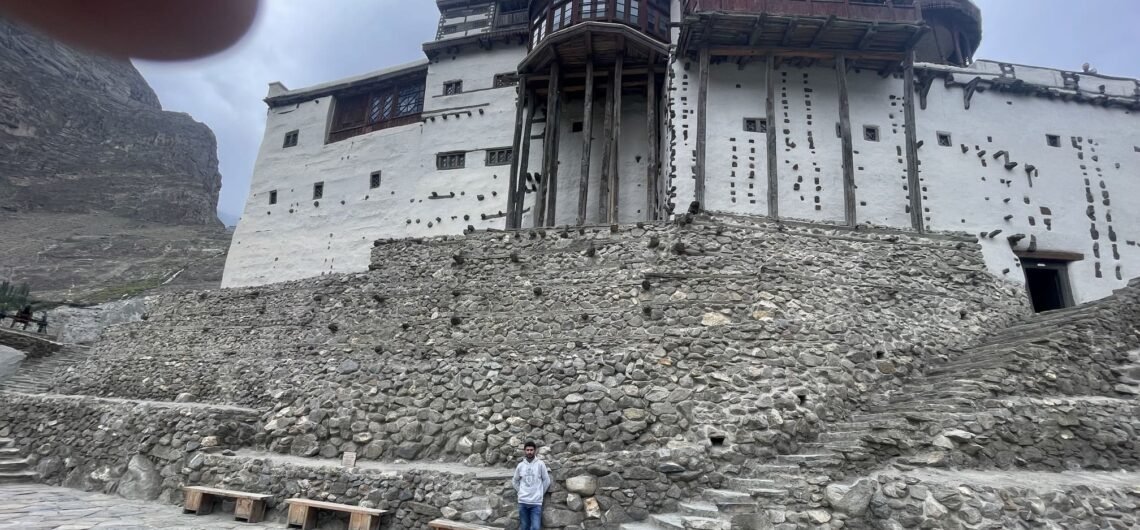
Located in the center of the Karakorum Mountain Range and along the historic Silk Route in Gilgit Baltistan. Hunza Valley offers picturesque landscape views. Hunza is a place where you can experience nature’s true mixture of beauty.
- Above 7000m snow-capped Peaks.
- From apricot orchards to Glacial rivers and alpine lakes.
- The ancient forts were along the old Silk Road.
- Most hospitable and humble locals.
This valley is more than perfect. Because it combines all the beauty of nature in a closed circuit around this valley. It’s the reason most tourists call Hunzal valley as “the perfect land”.
Hunza Valley Travel Guide – Geography That Feels Unreal
Peaks in this valley are:
- Rakaposhi (7,788m)
- Ultar Sar (7,388m)
- Ladyfinger Peak
- Passu Cones
From Karimabad, Hunza, a huge vertical tower of granite can never be seen anywhere around the world. The mountains are just close to the village, down like nowhere seen before.
Rakaposhi View Point – A Natural Balcony
When you travel via the KKH, you can experience the beauty of 7000m Rakaposhi Peak. It will take a few days for a short trek from downtown to the base camps of this beauty. There is a viewpoint on the KKH for this Peak, where many tourists stop for a few hours to capture the sight of Rakaposhi.
Popular Treks in Hunza
1. Rakaposhi Base Camp Trek
It is ideal for intermediate or moderate trekkers. You don’t need pro trekking skills to reach the base camp. It’s a few-day round-trip trek to the Rakaposhi base camp. You will experience walking through glaciers and lush green meadows throughout your journey.
2. Ultar Base Camp Trek
It provides you with magnificent glacial views close to Karimabad, Hunza. It’s a steeper path, so you should have good physical fitness.
3. Passu Glacier Trek
It’s a very easy trek and accessible within a day. It provides you with magnificent glacial landscapes.
You need huge logistics during the Baltoro, K2 base camp trek. But this valley is unique in the sense that it’s very much less complex logistically. There is a cozy guesthouse, 2-, 3-, and 4-star hotels, and especially prompt emergency evacuation. That is why foreign tourists with short time and low budgets prefer Hunza over other regions.
Karimabad Hunza – Living History in the Mountains
This very village is the cultural capital of Hunza. Because here you can explore:
- Baltit Fort (700+ years old)
- Altit Fort (1,100+ years old)
- Traditional Wakhi and Burusho communities
- Organic apricot orchards
Within the forts, you can witness the signs of the influence of Persia, Central Asia, and Tibet in the region. With the help of the AKRSP under their restoration projects, these forts are preserved using traditional techniques.
When you reach the wooden balcony of these forts, you can see the ancient irrigation system, death fall/cell, and watchtowers.
Attabad Lake Hunza – From Disaster to Wonder
With an undreamed natural landslide disaster back in 2010, Attabad Lake formed. What began as a catastrophe became one of the most photographed landscapes in pakistan.
Today, visitors enjoy:
- Kayaking
- Boating
- Lakeside stays
- Scenic photography
Passu Cones Pakistan – A Photographer’s Dream
If we make a list of places having a unique shape, then Passu Cones will top that list. Sharp granite peaks seem to be just placed in the ground and shoot up dramatically. Patagonia has jagged peaks, which is why many Europeans compare the Passu Cones with Patagonia.
Best Time to Visit Hunza Valley
The best time to visit Hunza Valley depends on your objective.
April–May
Cherry blossom period. Pleasant weather. Ideal for photography and city tours.
June–September
Mountain trekking period. Stable weather. Perfect mountain sights.
October
Golden autumn. Apricot trees turn red and orange. Winter travel is possible but suited for cultural tours rather than trekking.
Why Hunza Feels “Perfect”
1. Visual Perfection
Mountains dominate every direction. There is no industrial skyline. No urban chaos.
2. Cultural Warmth
Hunza communities are known for hospitality. English is widely understood in this region because of Hunza’s top literacy rate in Pakistan.
3. Safety and Stability
Gilgit-Baltistan’s tourism corridors are organized and scrutinized. Thousands of transnational tourists visit safely visit annually.
4. Clean Environment
Compared to many South Asian destinations, Hunza is remarkably clean. Plastic reduction campaigns are active. Hunza is the first in Pakistan to activate a successful campaign of plastic free region.
5. Adventure Without Overcrowding
Unlike Nepal’s Everest region, Hunza remains less commercialized. You experience space and silence through this valley.
Hunza Tour Packages – Structured Exploration
Generally, professional Hunza tour packages include:
- Airport pickup (Islamabad or Gilgit)
- Licensed Mountain Guides
- Trekking permits
- Accommodation
- Cultural exercise
- Transport on the Karakoram Highway
As an operator handling trekking logistics within the high-altitude regions of Pakistan, we stress:
- Certified guides
- Acclimatization protocols
- Weather monitoring
- Risk mitigation planning
What we say
If you are planning Hunza Valley trekking or exploring customized Hunza tour packages, ensure your operator understands high-altitude logistics, acclimatization science, and responsible tourism principles.
The Karakoram does not reward casual planning. But when done correctly, it offers one of the most powerful travel experiences on earth.
We are just an email away from providing every service you need.